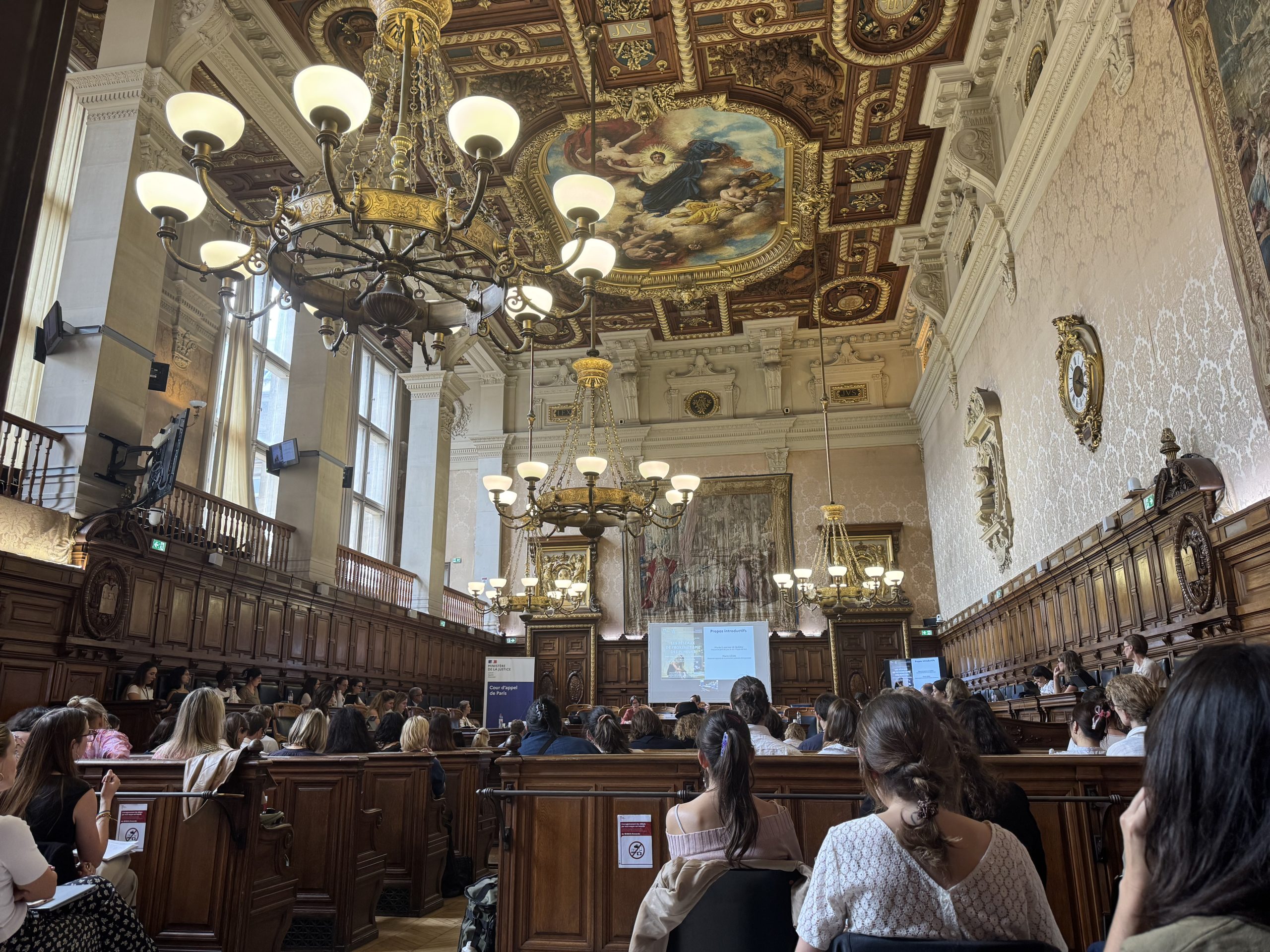
On 4th June 2026, Ambassador Michel Veuthey attended a seminar on minor’s prostitution networks in France organized by the Court of Appeal of Paris and the Ministry of Justice.
https://www.cours-appel.justice.fr/paris/colloque-sur-les-reseaux-de-proxenetisme-des-mineurs
Panel 1 : Fight Against Prostitution Networks
Speakers: Eric MATHAIS, Public Prosecutor of Bobigny / Valentine ALTMAYER, Chief Superintendent, Brigade for the Protection of Minors / Mathilde DELOUX, Magistrate at the Directorate of Criminal Affairs and Pardons (DACG), Bureau for the Fight against Organised Crime, Terrorism and Money Laundering / Alice MAZIERE, Magistrate, Mission Officer at the Inter-Ministerial Mission for the Protection of Women against Violence and the Fight against Human Trafficking / Vanessa BOUSARDO, Barrister, former Vice-Chair of the Paris Bar / Anne-Dominique MERVILLE, Advocate General
This first panel was dedicated to the fight against prostitution networks in France, a phenomenon whose scale has been growing steadily in recent years. Between 2017 and 2024, cases increased by 168%, with 171 files handled in 2025 by the Paris criminal investigation department alone. Most alarming is the sharp rise in the number of minors exploited by these networks, accounting for approximately 44% of victims identified by law enforcement. Faced with this deeply troubling phenomenon, it was noted that criminal and judicial resources are critically lacking, with the Brigade for the Protection of Minors having only 7 dedicated investigators.
Compounding this, the digitalisation of networks and the lack of cooperation from certain online platforms represent a major threat. Encrypted messaging applications and anonymised telephony obstruct the collection of evidence, while certain platforms such as Booking.com and Airbnb, on which apartments are rented for prostitution purposes, have been unwilling to cooperate with law enforcement. Speakers also highlighted the difficulty of interviewing victims, whether due to their refusal to cooperate or to the trauma they have suffered and the various substances they have ingested, most notably nitrous oxide, which impair their memory.
To address these challenges, the speakers underlined the need to favour the legal qualification of human trafficking, as it offers procedural advantages, including recourse to special investigative techniques and other exceptional legal frameworks. The role of support associations was equally emphasised, with 66% of complaints being filed when such associations are involved. The Ministry of Justice also highlighted the strengthening of training for magistrates in the area of human trafficking. Finally, the prosecution of clients remains a blind spot that requires greater attention, with fewer than 10% of cases leading to charges being brought against them.
Panel 2: Protecting Minor Victims of Prostitution Networks
Speakers: Delphine JARRAUD, Secretary General of the association L’Amicale du Nid / Magali FOUGERE-RICAUD, Magistrate seconded to the City of Paris, Head of the Bureau of Law and Adoption within the Directorate of Social Solidarity / Virgile BALES, Children’s Judge in Créteil / Alexandra LECOCQ, Barrister at the Versailles Court of Appeal, specialist in children’s law and former Secretary of the Conference / Anne COQUET, Lawyer General
This second panel focused on the protection and support of minor victims of prostitution networks. The speakers began by offering an overview of the issue: 94% of victims are girls, 99% of clients are men, with approximately 50,000 active listings every day and nearly 430,000 daily visitors on the main platforms. It was also highlighted that the average age of entry into prostitution is 15, but that an increasing number of very young victims (aged 10 to 12), are being reported, which illustrates the extreme gravity of the situation. Furthermore, victims very often present profiles of significant vulnerability: many are living in care homes, and as many as 77% have suffered sexual violence prior to their exploitation.
To better combat the phenomenon, speakers stressed the importance of child welfare services establishing a dedicated body with weekly case reviews, shared action plans, and reporting forms that feed into criminal investigations. Inter-institutional coordination was also identified as crucial: a rapid and synchronised educational, judicial and healthcare response is essential in order not to miss the window of opportunity when a minor seeks help. Finally, the lack of prevention was noted, including insufficient training for professionals, as well as a far too low rate of prosecutions of clients, leaving impunity largely unchallenged, which was identified as a structural factor that very broadly sustains the entire system.